
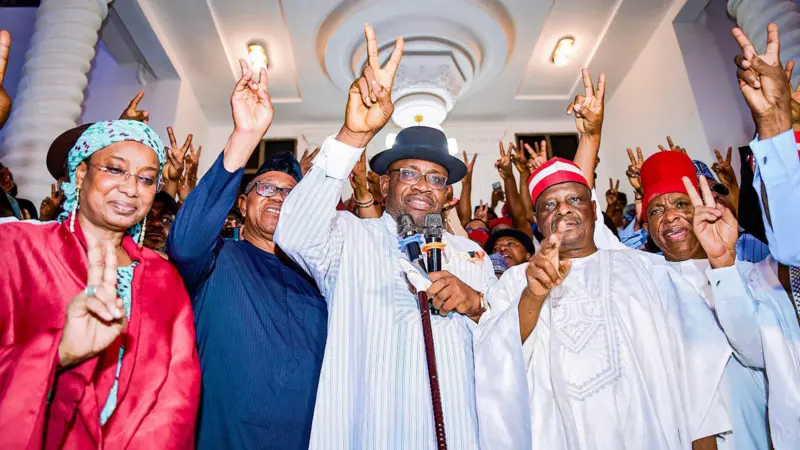
Obi, Kwankwaso Join New NDC; Remake 2027 Opposition Landscape
Former presidential aspirants Peter Obi and Rabiu Kwankwaso now anchor the nascent Nigeria Democratic Congress, signalling a bold realignment for the 2027 general election. Their move, following Obi's exit from the African Democratic Congress, positions NDC as a fresh battleground against established parties.
Peter Obi, the Labour Party's 2023 presidential candidate and former Anambra State Governor, along with Rabiu Kwankwaso, a 2023 presidential contender and former Kano State Governor, cement their political future within the newly formed Nigeria Democratic Congress (NDC). This pivotal move, announced on May 3, 2026, reshapes the opposition dynamics ahead of the crucial 2027 general election, signalling a direct challenge to incumbent power structures.
Obi's decision to join NDC comes hot on the heels of his departure from the African Democratic Congress (ADC). He cites “endless court cases, internal battles, suspicion, and division” within the ADC as the compelling reasons for his exit, a declaration he made public on his X handle. This marks the fifth political party Peter Obi has aligned with in his career, raising questions about stability and commitment.
The NDC, officially registered in 2026, positions itself as a response to demands for “disciplined governance, long-term national planning, and institutional accountability.” While ambitious, the immediate challenge for this fledgling party lies in consolidating power and attracting the significant national support required to compete effectively against Nigeria's political behemoths.
A New Opposition Force for 2027?
The combined electoral strength of Obi and Kwankwaso from the 2023 elections presents a formidable, albeit fragmented, base. Obi garnered over 6.1 million votes, placing third, while Kwankwaso secured nearly 1.5 million votes. Their alliance within NDC, a party less than five months old, aims to harness this support into a unified front capable of confronting the All Progressives Congress (APC) and the Peoples Democratic Party (PDP).
Analysts now scrutinise whether NDC can translate this initial momentum into a credible threat for 2027. The critical question remains: will the NDC grant either Peter Obi or Rabiu Kwankwaso its coveted presidential ticket? With INEC's primary election deadlines looming, the internal dynamics of the new party become paramount.
The initial expectation was a grand coalition involving Obi, Kwankwaso, and Atiku Abubakar, the 2023 PDP runner-up, under the ADC banner. However, the internal turmoil plaguing ADC ultimately scuttled those plans, forcing Obi and Kwankwaso to seek a fresh platform in the NDC.
NDC's Journey from Concept to Reality
The Nigeria Democratic Congress is one of two political parties recently registered by the Independent National Electoral Commission (INEC). Its official registration certificate was presented in February 2026. The party's website boasts an impressive network of 774 chapters nationwide and claims over one million registered members, a figure that, if accurate, indicates significant grassroots ambition.
The NDC's foundation rests on the vision of its founder and National Leader, Senator Henry Seriake Dickson, former Bayelsa State Governor and current Senator representing Bayelsa West Senatorial District. Senator Dickson, himself a former PDP member, initiated the party's registration process back in 2017. That initial attempt stalled under the previous INEC Chairman, Mahmood Yakubu.
The registration process resumed in 2025 when INEC lifted its embargo on new party registrations, attracting 171 applications. The NDC faced a legal challenge when INEC flagged its proposed two-finger logo for similarity to the APC's broom symbol. A subsequent court ruling, however, mandated INEC to register the NDC, paving its way into the political landscape. Senator Moses Cleopas serves as the NDC's National Chairman, alongside other key national working committee members.
Obi's Shifting Alliances and Supporter Loyalty
Peter Obi's political odyssey is marked by a series of party affiliations. He first entered full-time politics contesting the 2003 Anambra State gubernatorial election under The All Progressives Grand Alliance (APGA), winning after a court overturned the initial result. He later joined the PDP, becoming Atiku Abubakar’s vice-presidential running mate in 2019. In 2022, he moved to the Labour Party for his 2023 presidential bid.
This pattern of party hopping now raises critical questions about the sustained loyalty of his devoted supporters, often referred to as the Obidients. Their fervent backing has been a defining feature of his recent campaigns, but continuous shifts in platform could test the resilience of this base.
As Obi and Kwankwaso emerge as the most prominent figures within the NDC, political observers keenly watch the party's next steps. While the path to the presidential ticket remains undefined, their presence signals NDC as a party to watch in the unfolding drama of the 2027 election cycle.
Help surface this story to your network.
Related stories
Obi, Kwankwaso's ADC Exit: A Reckoning for Nigeria's 2027 Election Cycle
Peter Obi and Rabiu Musa Kwankwaso's dramatic exit from the African Democratic Congress (ADC) reshapes Nigeria's political landscape, signaling a deep loss of confidence in the party system. This strategic withdrawal highlights how legal uncertainties and judicial interventions now dictate political viability, not just internal party dynamics. The move forces a critical look at the true strength of Nigeria's democracy ahead of the 2027 general elections.
Datti Baba-Ahmed: Obi-Kwankwaso 2027 Alliance Lacks Northern Support, Leadership Questioned
Datti Baba-Ahmed, former Labour Party VP candidate, declares northern Nigeria will not back a Peter Obi and Rabiu Kwankwaso presidential ticket in 2027. He also sharply criticizes Obi's "walk away" approach to party crises, arguing it betrays weak leadership ahead of crucial political realignments.
Supreme Court Sends ADC Leadership Tussle Back to Trial Court
The Supreme Court has cleared a major legal hurdle for the David Mark-led faction of the African Democratic Congress, nullifying an Appeal Court order for parties to maintain status quo. This decision pushes the fierce leadership battle back to the Federal High Court, where the substantive challenge against Mark’s authority now proceeds.
The Oracle
INTELLIGENCE ANALYST
Join the intelligence network.
Daily political intelligence delivered at 7am. You are the stakeholder.
50,000+ Nigerians. Free intelligence. Every morning at 7am.