
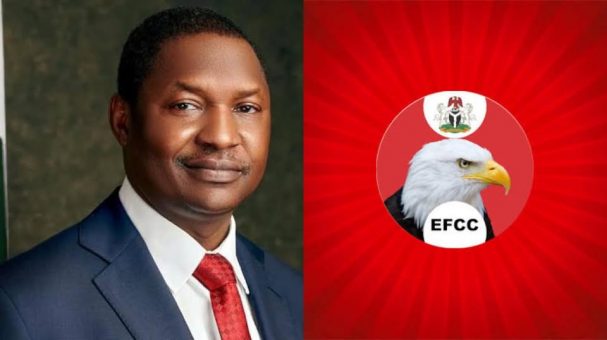
Abubakar Malami Challenges EFCC Forfeiture Order, Declares Assets Legit
Abubakar Malami, SAN, former Attorney General of the Federation, confronts the Economic and Financial Crimes Commission (EFCC) in court, challenging an interim order to forfeit his assets. Malami declares his properties legitimately acquired through decades of legal practice and business, dismissing EFCC's allegations as speculative and accusing the agency of inflating asset values. This high-stakes legal battle scrutinizes the EFCC's operational scope and due process.
Abubakar Malami, SAN, former Attorney General of the Federation, throws down the gauntlet against the Economic and Financial Crimes Commission (EFCC), initiating a legal challenge to reclaim properties under interim forfeiture. Malami insists his substantial assets stem from legitimate earnings, not illicit means, escalating a high-stakes confrontation with the nation’s anti-graft agency.
In a detailed affidavit filed before the Federal High Court of Nigeria in Abuja, Malami asserts that the properties listed in the EFCC's January 2026 interim forfeiture order were honourably acquired. He credits over three decades of a thriving legal practice, shrewd business ventures, and fully declared income for his wealth. He further details loans from commercial banks, strategic asset sales, gifts, and proceeds from book launches as additional sources, maintaining all earnings are duly reported to the Code of Conduct Bureau.
The EFCC secured the forfeiture order, citing suspicions that the properties constitute proceeds of crime. However, Malami vehemently counters this, arguing the anti-graft agency offers no prima facie evidence linking his assets to any criminal activity. He dismisses the EFCC's allegations as purely speculative, declaring, “There is no document before the court showing these properties were acquired with proceeds of crime.”
Challenging Valuation and Due Process
Beyond the lack of concrete evidence, Abubakar Malami accuses the EFCC of deliberately inflating the value of his properties. He claims assets purchased for hundreds of millions of naira are presented as being worth billions, a calculated move to bolster the agency's case. Independent valuers, he points out, provide significantly lower and more accurate assessments, exposing the EFCC’s alleged distortion.
Malami further alleges that the EFCC has overstepped its statutory authority. He accuses operatives of seizing properties without a final forfeiture order, aggressively evicting his family members, and confiscating crucial documents. These actions, he states, are extrajudicial and a blatant violation of due process, undermining the rule of law.
The former AGF now urges the Federal High Court to set aside the interim forfeiture order. He unequivocally maintains that his assets are legitimate, completely unconnected to any unlawful activity, and demands an end to what he describes as arbitrary actions by the anti-graft body.
Legal Battle Redefines Anti-Graft Powers
This pivotal case, intertwined with an ongoing criminal charge against Abubakar Malami, SAN, promises to significantly test the boundaries of the Economic and Financial Crimes Commission’s asset forfeiture powers. The court’s decision will clarify adherence to due process and set a crucial precedent for future anti-graft operations, impacting how the EFCC pursues alleged illicit wealth across Nigeria.
Help surface this story to your network.
Related stories
The Oracle
INTELLIGENCE ANALYST
Join the intelligence network.
Daily political intelligence delivered at 7am. You are the stakeholder.
50,000+ Nigerians. Free intelligence. Every morning at 7am.